Android Utilities
AppScope
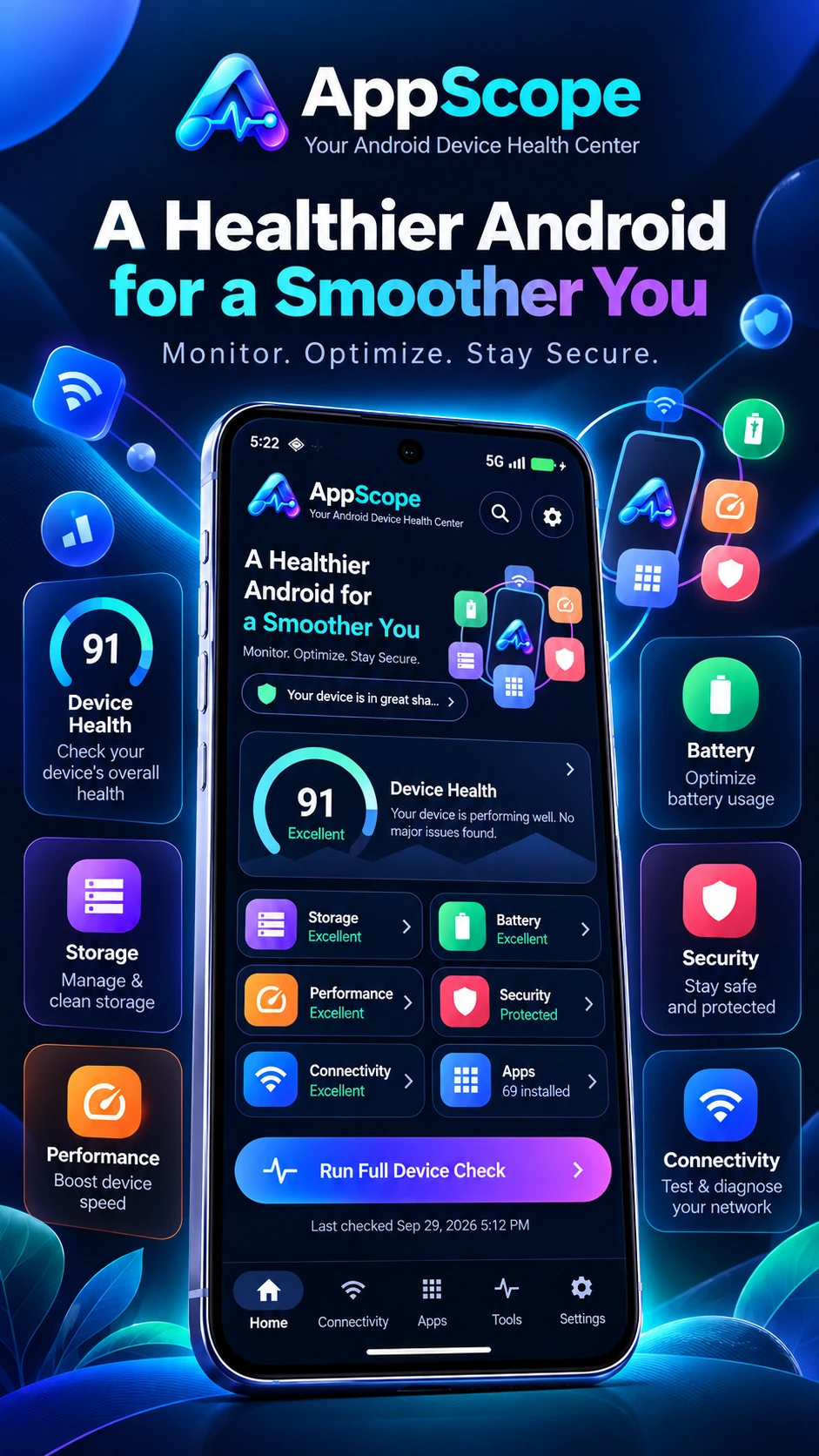
AppScope was built to address a clear gap: there was no single place to check whether an Android phone was actually healthy. The product consolidates battery, storage, connectivity, and security signals the OS already exposes into one score, with plain-language guidance instead of raw technical readouts.
Role
Product design, native Android development, Play Store launch
Problem
Checking a phone's health usually meant bouncing between four or five separate utility apps — a battery app, a storage cleaner, a security scanner — each with its own ads, permissions, and inconsistent advice.
Result
AppScope replaced the need for several single-purpose utility apps with one lightweight health center, built and shipped independently end-to-end.
User Research
Wireframes and Flow
Step 1
Sketched a single health-score home screen with four signal tiles instead of a tab-per-feature structure.
Step 2
Prototyped a detail view per signal that explains the number in plain language before showing the raw data.
Step 3
Tested a "what to do next" action card pattern so a low score always pairs with a concrete next step.
Design Decisions
One score, one screen
The home screen leads with a single health score rather than four competing dashboards, so the overall state is legible at a glance.
Plain-language diagnostics
Every signal pairs a raw value with a short explanation of what it means and whether it needs attention.
No dark patterns
Unlike most "cleaner" apps in the category, AppScope never relies on inflated warnings to drive ad views or upsells.
Development Approach
Architecture
End-to-end flow & key technologies
How AppScope is actually built — from the raw data source or input method, through the logic that processes it, down to what the user sees — with the specific tools behind each stage.
System & Sensor Layer
01 / 04Android System APIs
Raw battery, storage, connectivity, and security signals are read directly from the OS — no server round-trip for data that already lives on-device.
Background Processing
02 / 04WorkManager Collectors
Periodic background jobs refresh each signal on a battery-friendly schedule instead of polling constantly in the foreground.
Business Logic
03 / 04Health Score Engine
Combines the four raw signals into one plain-language score and decides what, if anything, needs a "next step" action card.
Presentation
04 / 04Material Design 3 Dashboard
Surfaces the single health score on the home screen, with a per-signal detail view available one tap away.
Challenges and Solutions
Reading signals Android does not expose directly
Several 'health' indicators, like a true storage breakdown or realistic battery health, are not exposed as a single clean API.
Combined several lower-level system APIs and derived metrics to approximate each signal reliably across different Android versions and OEM skins.
Differentiating within a crowded, trust-sensitive category
The device-optimization app category is saturated with apps that overstate problems to justify their value.
Kept claims conservative and avoided urgency-driven patterns entirely, prioritizing long-term trust over short-term engagement.
Outcome
Live
Published and maintained on Google Play
4
Device health signals unified in one score
1
Dashboard replacing several single-purpose utility apps
Final outcome
AppScope shipped as a focused, single-purpose utility rather than another all-in-one cleaner app.
The health-score format made the phone's state understandable without reading raw stats.
The project became a template for shipping independent Android utilities end-to-end, from design through Play Store release.
Key Features
Tech Stack
Why it worked
The solution aligned product strategy, UX hierarchy, and engineering discipline so users got a simpler experience and the team gained a more durable delivery foundation.